Understanding BIM Dimensions: Meaning, Applications, and Benefits

Building Information Modelling (BIM) has revolutionized the way we design, construct, and manage buildings and infrastructure. One of the most powerful aspects of BIM is its ability to represent various “dimensions” of information—far beyond just 3D modelling. Each BIM dimension adds a layer of insight and functionality to a project, contributing to smarter decisions throughout the lifecycle of a built asset.
In this article, we’ll explore the different BIM dimensions—from 2D to 7D and beyond—their meanings, practical applications, and why they matter.
2D – The Starting Point

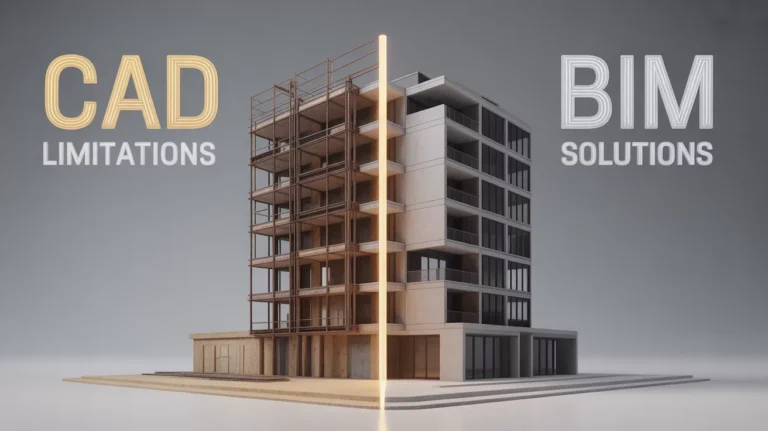
Before diving into BIM dimensions, it’s useful to understand that traditional 2D drawings (like plans and sections) represent the earliest stage of digital documentation. Though technically not part of the BIM dimensional spectrum, they serve as the foundation for moving toward data-rich, model-based workflows.
3D BIM – The Digital Geometry
Meaning: This is the core of BIM, representing the 3D geometry of a building or structure.
Application: Architects, engineers, and designers use 3D BIM to visualize spatial relationships, detect design clashes, and ensure coordination among different disciplines.
Benefits:
- Better visualization and design communication
- Clash detection between systems (e.g., plumbing vs. electrical)
- Fewer design errors and rework
4D BIM – Time Scheduling
Meaning: Adds the dimension of time to the 3D model.
Application: Used primarily by project managers and construction planners to link construction tasks with the model geometry and visualize the construction sequence.
Benefits:
- Improved project scheduling and phasing
- Helps simulate construction progress
- Reduces delays through better planning
5D BIM – Cost Estimation
Meaning: Integrates cost data into the 3D model to support accurate budget tracking.
Application: Quantity surveyors and cost consultants use 5D BIM for automated quantity take-offs and cost estimation tied directly to model elements.
Benefits:
- Real-time cost updates as designs change
- Transparent budgeting
- Reduces risk of cost overruns
6D BIM – Sustainability & Energy Analysis
Meaning: Incorporates environmental and energy performance data into the model.
Application: Used for energy simulation, daylight analysis, and carbon footprint evaluation during design and operation phases.
Benefits:
- Helps design more energy-efficient and sustainable buildings
- Supports green certifications (like LEED, GRIHA)
- Enhances long-term performance tracking
7D BIM – Facility Management
Meaning: Extends BIM data into the operation and maintenance phase of a building.
Application: Facility managers use 7D BIM to access detailed asset information such as serial numbers, maintenance schedules, and supplier contacts.
Benefits:
- Streamlined building operations
- Improved asset lifecycle management
- Reduces maintenance costs
Beyond 7D – Future-Proofing BIM
Though not universally standardized, some practitioners refer to 8D BIM (safety planning) and 9D BIM (lean construction and waste reduction). These dimensions aim to push BIM into new areas of project management and innovation.
Why Understanding BIM Dimensions Matters
Whether you’re an architect, engineer, planner, or facility manager, understanding BIM dimensions helps you:
- Collaborate more effectively across disciplines
- Make informed decisions at every project stage
- Add measurable value to your work and to the client
Conclusion
BIM is not just about creating 3D models—it’s about embedding intelligence into every layer of the project. From design visualization to post-construction facility management, the various dimensions of BIM offer a comprehensive, integrated approach to building lifecycle management. As BIM continues to evolve, professionals who understand and apply these dimensions will be better equipped to lead the future of the built environment.